
Notifications
Clear all

Topic starter
- Rationalise the denominator of the following fraction. $$\frac{1}{\sqrt{6}-\sqrt{3}+\sqrt{2}+1}$$
A. $\frac{\sqrt{6}+\sqrt{3}-\sqrt{2}+1}{2}$
B. $\frac{\sqrt{6}-\sqrt{3}+\sqrt{2}+1}{2}$
C. $\sqrt{6}-\sqrt{3}+\sqrt{2}+1$
D. $\sqrt{6}+\sqrt{3}-\sqrt{2}+1$
E. $\sqrt{6}-\sqrt{3}-\sqrt{2}+1$ - If adding 1 to the numerator and adding 5 to the denominator of a fraction is the same as subtracting 5 from the numerator and subtracting 1 from the denominator of the same fraction, then find the fraction if its decimal expansion is 1.5.
A. $\frac{6}{5}$
B. $\frac{12}{8}$
C. $\frac{4}{12}$
D. $\frac{12}{6}$
E. $\frac{10}{8}$ - Two vectors in the 3-D Euclidian space are given $$4\hat{i}+ 9\hat{j}− 13\hat{k} \text{ and } 7\hat{i}+ 6\hat{k} + 5\hat{j}$$ Find the dot product of the 2 vectors.
A. 17
B. 147
C. 5
D. 151
E. None of these - Find 𝑀𝑁 − 𝑀 − 𝑁 in the rational equation below. $$\frac{52x+73}{14x^2+83x+33}=\frac{M}{7x+3}+\frac{N}{2x+11}$$
A. 19
B. 13
C. 16
D. -22
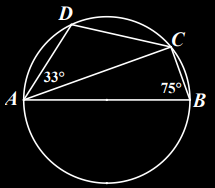
E. 7 - In the adjoining figure, 𝐴𝐵 is the diameter of the circle and 𝐶, 𝐷 lie on the same side of the diameter. If ∠𝐴𝐵𝐶 = 75° and ∠𝐷𝐴𝐶 = 33°, then find the measurement of ∠𝐷𝐶𝐴, in degrees.
A. 33
B. 24
C. 72
D. 42
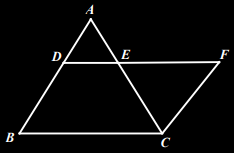
E. 27 - In the adjoining figure Δ𝐴𝐵𝐶, point 𝐷 is on 𝐴𝐵 such that 𝐵𝐷 = 3𝐴𝐷, 𝐸 is a point on 𝐴𝐶 such that 𝐷𝐸||𝐵𝐶, 𝐹 is a point on the line 𝐷𝐸 such that 𝐴𝐵||𝐶𝐹 Find the length of 𝐸𝐹 if 𝐵𝐶 = 16.
A. 12
B. $\frac{32}{3}$
C. 4
D. 8
E. Not uniquely determined - A tangential quadrilateral 𝐴𝐵𝐶𝐷 is a convex quadrilateral whose sides are tangent to a circle. Given that 𝐴𝐷 = 16, 𝐵𝐶 = 8 and the radius of the circle is 4, find the area of the quadrilateral.
A. 48
B. 24
C. 144
D. 96
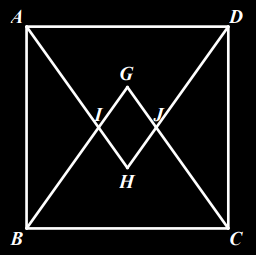
E. 192 - In the diagram, 𝐴𝐵𝐶𝐷 is a square, 𝐴𝐻𝐷 and 𝐵𝐶𝐺 are equilateral triangles. Points 𝐼 and 𝐽 are intersection points of the sides of the triangles as shown. Given the length of a side of the square is 6, find the area of the rhombus 𝐼𝐺𝐽𝐻.
A. 24$\sqrt{3}$ − 36
B. 6
C. 48 − 24$\sqrt{3}$
D. 12
E. 3$\sqrt{3}$ - What is the greatest number of regions can 7 lines divide a circle into?
A. 14
B. 28
C. 29
D. 15
E. 35 - If ℎ(𝑥) = 2 + $\sqrt{x}$ and 𝑓(ℎ(𝑥)) = 7 + 5$\sqrt{x}$ + 𝑥 then find 𝑓(3).
A. 13
B. 10 + 5$\sqrt{3}$
C. 8
D. 10
E. 12 - In a sequence of numbers, each subsequent term is the sum of cubes of digits of the previous term. If one such sequence starts with the number 457, find the 2021st term in it.
A. 352
B. 160
C. 217
D. 153
E. 371 - The first 5 terms of a sequence are: $$5, 9, 16, 28, 47$$ Find the sum of the 8th and 7th terms.
A. 189
B. 210
C. 280
D. 241
E. 166 - How many unique necklaces can be made such that they contain 7 equally spaced beads of 7 different colours?
A. 5040
B. 720
C. 2520
D. 360
E. 840 - Find the value of: $$\sum_{j=2}^{\infty}\left( \sum_{j=1}^{\infty}\frac{1}{9i} \right)^{\frac{j}{3}}$$
A. 1
B. $\sqrt[3]{\frac{1}{7}}$
C. $\frac{1}{2}\times\sqrt[3]{\frac{1}{7}}$
D. $\frac{1}{2}$
E. $\frac{1}{7}$ - Given 𝑓: 𝑅 → 𝑅 is a quadratic polynomial $$𝑓(1) = 1, 𝑓(2) =\frac{1}{2},f(3)=\frac{1}{3}$$ Find $f(4)$.
A. $\frac{1}{4}$
B. 4
C. $\frac{7}{24}$
D. $\frac{1}{2}$
E. Insufficient information - For positive real numbers 𝑥, 𝑦 and 𝑧, it is given that $$\frac{x}{3y+2z}+\frac{3y}{x+2z}+\frac{2z}{x+3y}=\frac{3}{2}$$ Find the value of $$\frac{(7x+12y)^2}{z^2}$$
- How many times the digit ‘0’ appears in the list of numbers from 1000 to 2021 including both numbers?
- If $𝑓(𝑥) = 2^𝑥 + 86$ and $𝑔(𝑥) = 3𝑥^2 + 𝑥 − 4$ then find: $$𝑔[𝑓^{−1}(𝑔(14))]$$
- What is the shortest distance an ant needs to travel from its current position (7,10) to the anthill (19,25) if the ant must touch the x-axis where sugar is spread all along with it?
- A number in base 3 has all its digits as 1, but its last digit is 0 in base 2. Which is the largest 4-digit number, in base 10, that has this property?
- If the following is given: $$𝑥^4 + 𝑥^3 + 𝑥^2 + 𝑥 + 1 = 0$$ Then find the value of $𝑥^{2021 − x}$.
- Find the sum of three positive integers 𝑝, 𝑞, 𝑟, if the following is given:

- Find the ordered set of 4-tuples, of positive integers, [𝑤, 𝑥, 𝑦, 𝑧] such that: $$𝑤 + 𝑥 + 𝑦 + 𝑧 = 21$$
- Find the value of a positive integer 𝑥. $$x=\sqrt{5+\sqrt{13+\sqrt{5+\sqrt{13+...}}}}$$
- Seven unique awards need to be handed to 7 exceptional students. If the probability that the chief guest hands all awards to the incorrect recipient is $\frac{a}{b}$ in simplest form, then find the value of 𝑎 + 𝑏. (It is given that the probability to do so with 5 and 6 awards is $\frac{11}{30}$ and $\frac{53}{144}$, respectively.)
This topic was modified 4 bulan ago by Admin dot
Posted : 19/06/2026 6:35 am
