
Notifications
Clear all

Topic starter
- How many numbers of the series have a terminating decimal expansion? $$\frac{1}{1},\frac{1}{2},\frac{1}{3}\cdots\frac{1}{98},\frac{1}{99},\frac{1}{100}$$
A. 15
B. 16
C. 14
D. 13
E. 18 - Solve: $$\sqrt{4^3}-\sqrt[3]{2^6}$$
A. 2
B. 4
C. 8
D. 12
E. 1 - Solve the following $$(\sqrt[3]{7}-1)\times(\sqrt[3]{49}+\sqrt[3]{7}+1)$$
A. 48
B. 50
C. 6
D. 8
E. 7 - How many positive integers 𝑁 satisfy the following equation. $$441 − 42𝑁 + 𝑁^2 = 64$$
A. 2
B. 1
C. 0
D. 4
E. 3 - Find the sum of all the unique prime factors of 656656.
A. 74
B. 1044
C. 553
D. 473
E. 687 - In the adjoining figure, 𝐴𝐵 is the diameter of the circle and 𝐶, 𝐷 lie on the same side of the diameter. If ∠𝐴𝐵𝐶 = 75° and ∠𝐷𝐴𝐶 = 33°, then find the measurement of ∠𝐷𝐶𝐴, in degrees.
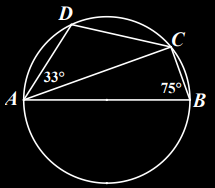
A. 33
B. 24
C. 72
D. 42
E. 27 - A metal cylinder is re-casted into a cone with twice the radius. If the height of the cylinder was 12 m, then what is the height of the new cone?
A. 24 m
B. 16 m
C. 6 m
D. 9 m
E. 36 m - In the diagram, 𝐴𝐵𝐶 is a right-angled triangle, 𝐴𝐷 = 4 and 𝐶𝐷 = 6. Find the length of 𝐷𝐵 if 𝐶𝐷 is perpendicular to 𝐴B.
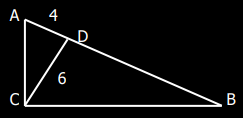
A. 8
B. 9
C. 10
D. 4
E. 12 - A rhombus of the length 17 and the length of one of its diagonals is 16. Find the length of the other diagonal.
A. 15
B. 30
C. 32
D. 34
E. $\sqrt{545}$ - Tom travels first 25 km with a speed of 60 km/h. Then due to the conditions of the remaining road, he had to slow down and travel the rest of the distance with a speed of 𝑥 km/h. If the average speed over 50 km was found to be 40 km/h. Find the value of 𝑥.
A. 36
B. 20
C. 30
D. 15
E. None of these - Count the number of square numbers between (6^4 + 1) and (4^6 − 1).
A. 28
B. 17
C. 29
D. 16
E. 27 - Find the 1000th root of $10^{(10^{10})}$
A. $10^{(10^{7})}$
B. $10^{(7^{10})}$
C. $\sqrt{10}^{(\sqrt{10}^{\sqrt{10}})}$
D. $7^{(10^{10})}$
E. $10^{\frac{1}{10}}$ - A cuboid has faces of area 24, 15, 10 square units. If the lengths of the sides of the cuboid are 𝑎, 𝑏, 𝑐 then find 𝑎𝑏𝑐 + 2(𝑎 + 𝑏 + 𝑐).
A. 72.5
B. 49
C. 90
D. 85
E. Insufficient information - What is the greatest number of regions can 7 lines divide a circle into?
A. 14
B. 28
C. 29
D. 15
E. 35 - How many unique necklaces can be made such that they contain 7 equally spaced beads of 7 different colours?
A. 5040
B. 720
C. 2520
D. 360
E. 840 - In the figure, the difference between any two neighbouring horizontal and vertical dots is 1. Find the area of the triangle.
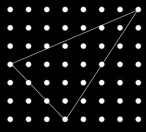
- If 𝑛! = 𝑛 × (𝑛 − 1)! × … × 2 × 1, find the simplest value of the following. $$\frac{20!+21!}{2\times 19!+4\times 19!+16\times 19!}$$
- What is the number of unique 4 letter words that can be formed with the word MATHS?
- In a 3-digit number XYZ, X, Y and Z are non-zero digits in an arithmetic progression. If XYZ - ZXY = M, find the largest value of M a 3-digit number (X, Z≠0).
- In a class of 50 students if 15 like maths, 27 like English and 13 like none then how many like both Maths and English.
- The numbers 411, 666 and 870 give the remainder when divided by a positive integer 𝑁. Find the greatest possible value of 𝑁.
- In a sequence of numbers, each subsequent term is the sum of cubes of digits of the previous term. If one such sequence starts with the number 244, find the 2021st term in it.
- In how many ways can you reach any circle on the 10th row from the circle on the top if you can only move down left or right but cannot pass through the black circle?
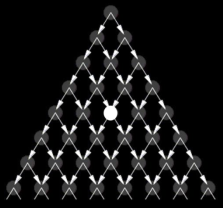
- Find the maximum value of the following expression. $$\sqrt{781-X}+\sqrt{X-59}$$
- The factorisation of a semi-prime number is $𝑝_1 × 𝑝_2$ where $𝑝_1$ and $𝑝_2$ are prime numbers. Let the probability that the sum of faces of 3 standard dice is a semi-prime number be $\frac{𝑎}{𝑏}$ in simplest form. Find the value of 𝑎 + 𝑏.
Posted : 19/06/2026 4:52 am
